
LAND · SEA · MAKING
Arts & Material Culture
Creativity shaped by land, sea, spirit, and community.
Taíno makers worked with stone, wood, clay, shell, bone and plant fibers. Their creations served daily life, ceremony, leadership and exchange, carrying knowledge and relationships as well as artistic skill.
“Art” and “material culture” are modern ways to organize this learning. One object could be useful, spiritually significant and politically important at the same time. Surviving works offer partial glimpses; artists today explore Caribbean heritage in new forms.
Read the museum introduction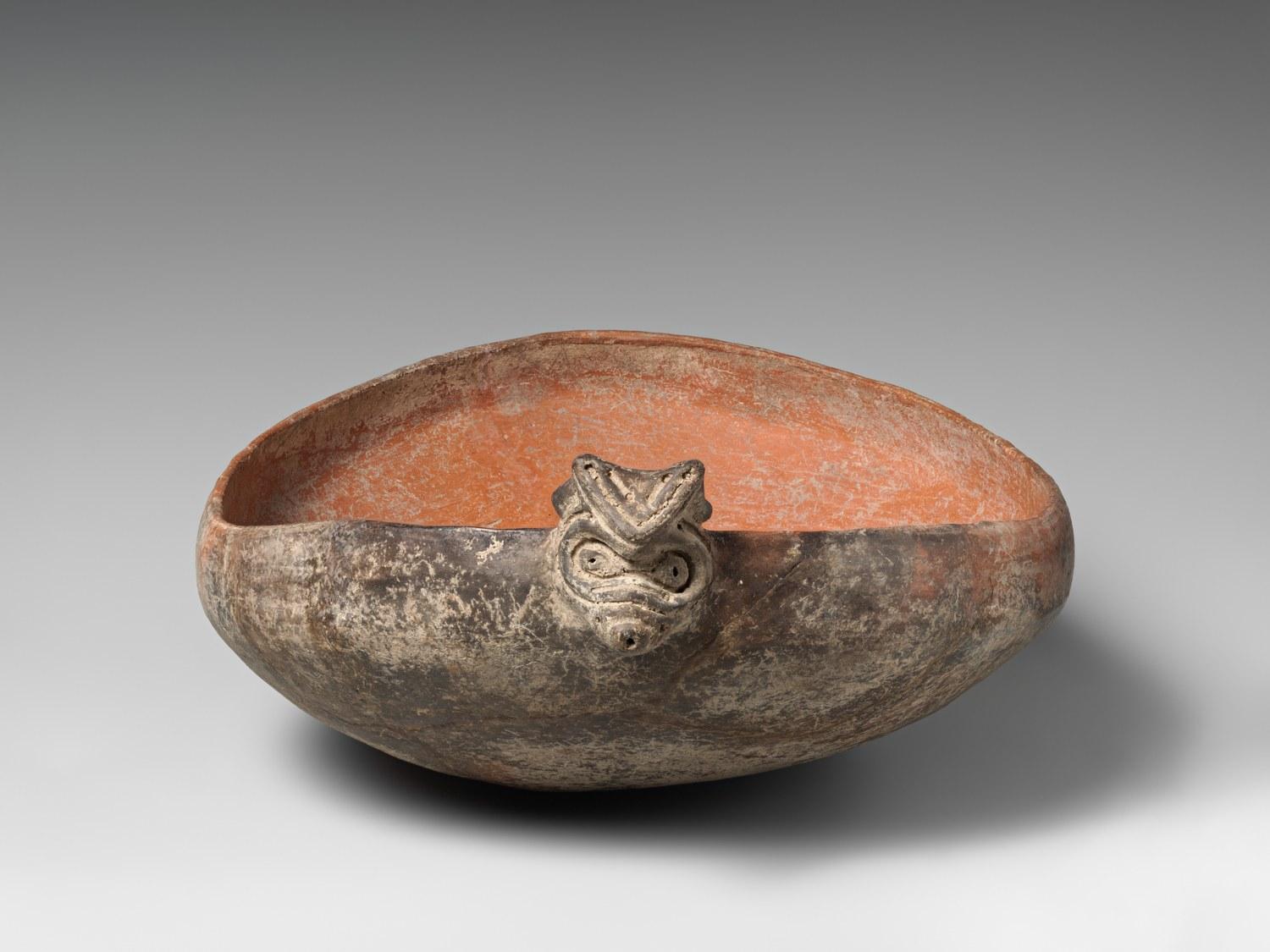
A wide ceramic vessel with a modeled face at its rim. Looking closely begins with what is visible, before assigning a purpose.
Maker unrecorded · 13th–15th century · Ceramic · Dominican Republic · Taíno
Object record & photograph credit
The Metropolitan Museum of Art, 1984.201. Purchase, Mary R. Morgan, Mary O'Boyle II and Mr. and Mrs. Frederick E. Landmann Gifts; The Michael C. Rockefeller Memorial Collection, Gift of Nelson A. Rockefeller and Bequest of Nelson A. Rockefeller, by exchange, and Gift of Nathan Cummings, by exchange, 1984
Photographer unidentified in the record. Documentary photograph; resized and JPEG compressed, without retouching.
01 · MATERIALS & MAKING
Skill takes many forms
Stone
Carving and polishing
Wood
Carving and, in some works, inlay
Clay
Modeled vessels and surface decoration
Shell & bone
Ornaments and carved implements
Plant fibers
Cotton work, basketry and hammocks
Metal & inlay
Gold or other additions documented in particular works
The objects here ground these descriptions: the bowl is ceramic, the pendant is shell, and the three-cornered sculpture is stone. The wooden cohoba stand preserves shell inlay. A photograph alone cannot establish every tool, firing condition or step used to make an object.
02 · PRESENCE & FORM
Cemís: more than sculpture
Cemí and zemí are spelling variants used by different sources. Museum and scholarly accounts relate them to spiritual and ancestral forces, and to the trees, stones and objects through which those relationships took form. We retain “zemí” in museum titles.
Three-cornered stones vary in size and imagery. Scholars connect some forms to cassava and island landscapes, but a triangular shape is not a universal key to one deity. This object’s face and three-pointed form are observable; its full original meaning is not recovered by its collection title.
Explore ceremony in Taíno Medicine →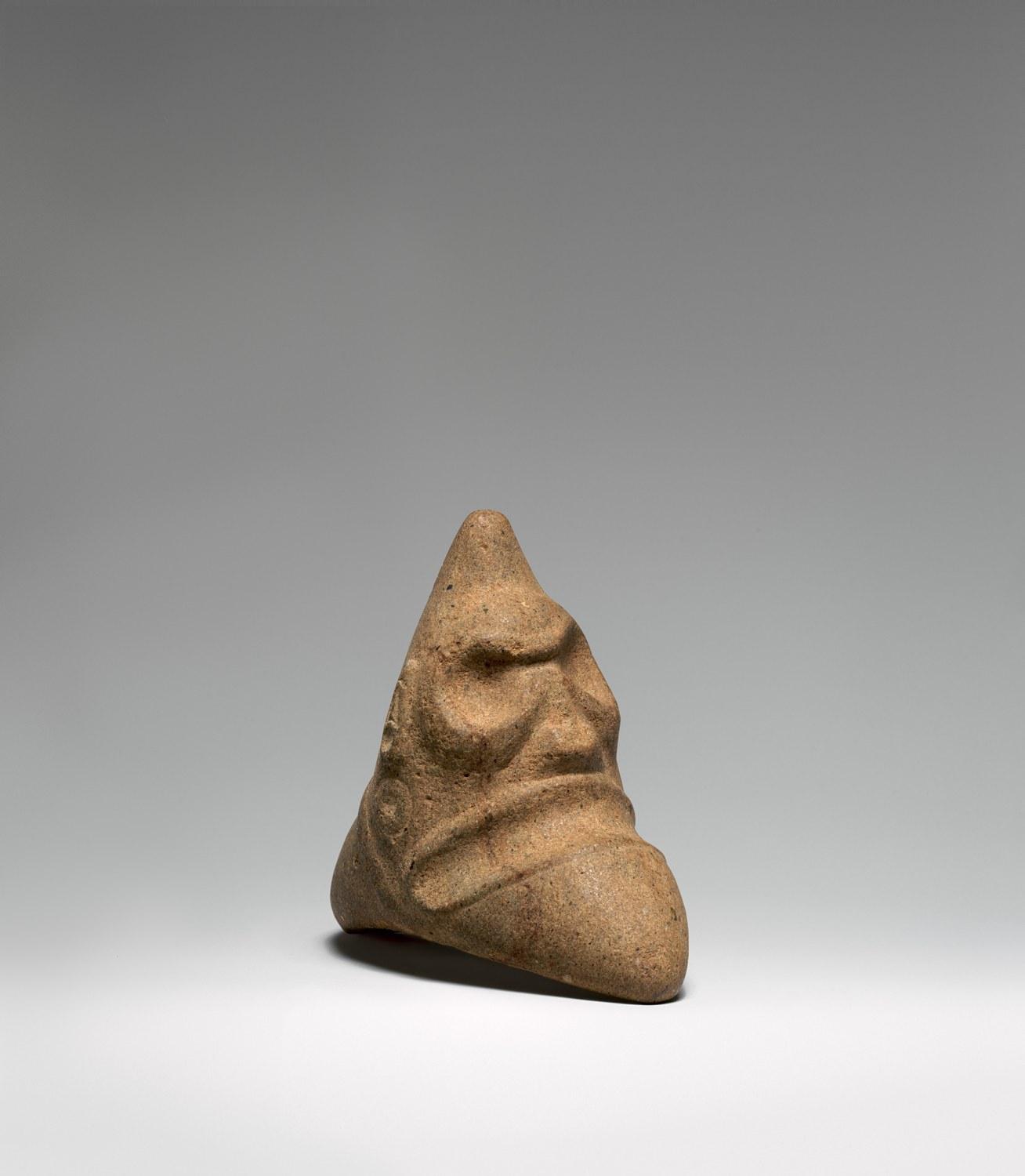
The carved face follows the rising contours of this three-cornered stone. No specific deity is assigned here.
Maker unrecorded · 13th–15th century · Stone · Dominican Republic · Taíno
Object record & photograph credit
The Metropolitan Museum of Art, 1983.543.1. Gift of Mr. and Mrs. David Heller, 1983
Photographer unidentified in the record. Documentary photograph; resized and JPEG compressed, without retouching.
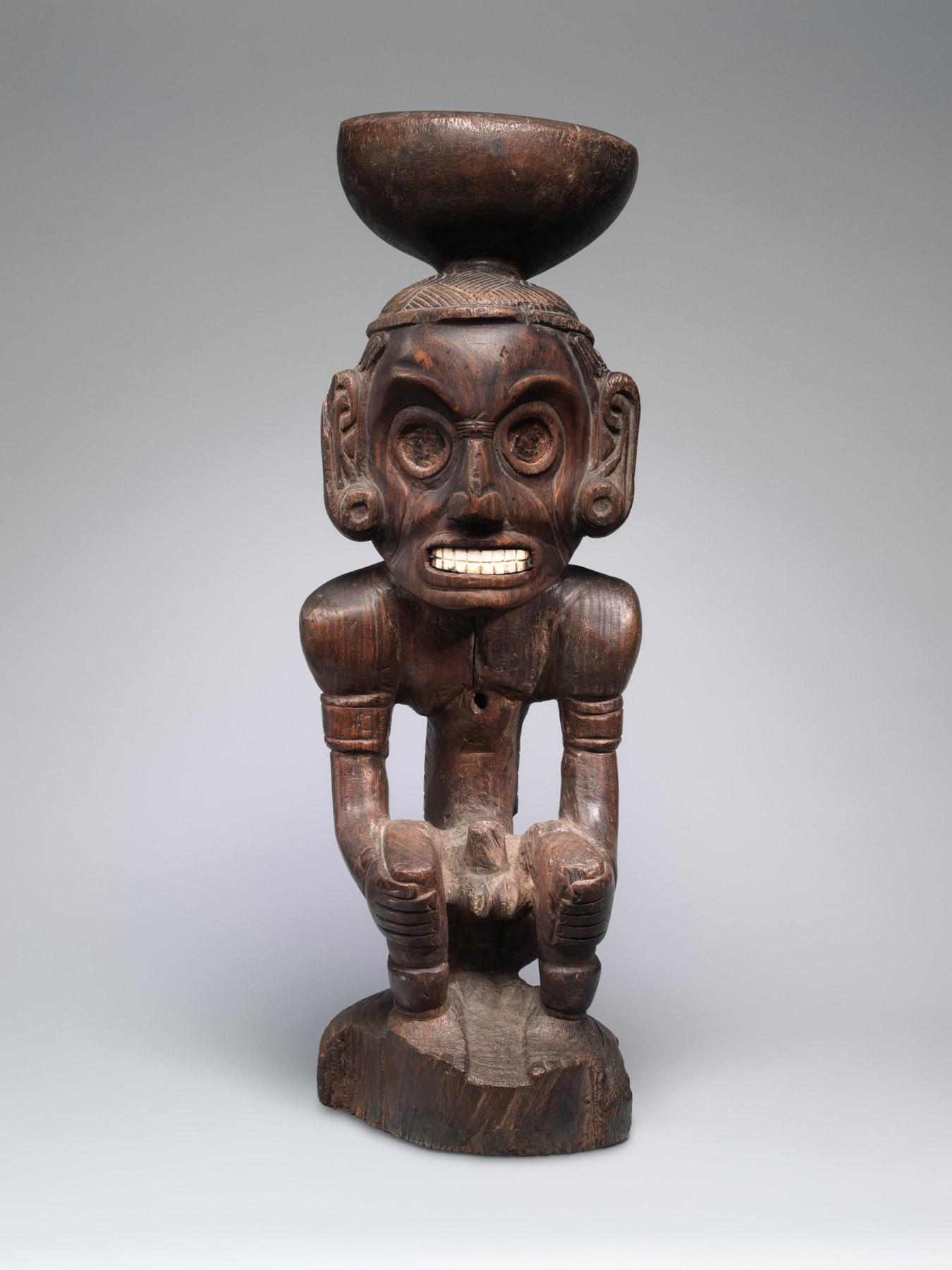
Maker unrecorded · ca. 1000 CE · Guaiacum wood, shell · Taíno · Dominican Republic (?), as catalogued.
The Met, 1979.206.380. The Michael C. Rockefeller Memorial Collection, Bequest of Nelson A. Rockefeller, 1979.
Object record · CC0Documentary photograph; photographer unrecorded. Resized and compressed.
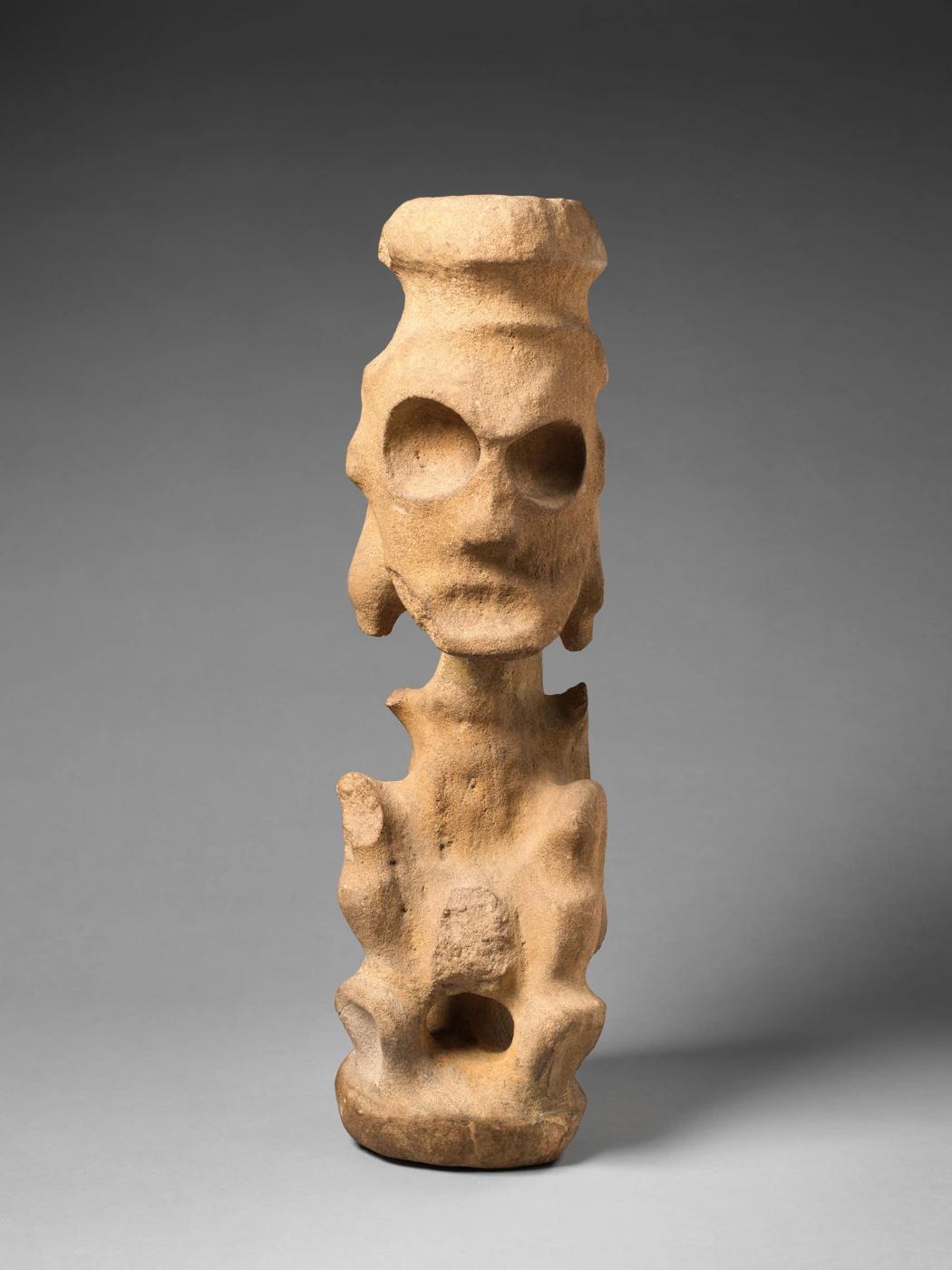
Maker unrecorded · 1200–1500 CE · Stone (biocalcarenite) · Taíno · Dominican Republic (?).
The Met, 1979.206.1209. The Michael C. Rockefeller Memorial Collection, Bequest of Nelson A. Rockefeller, 1979.
Object record · CC0Documentary photograph; photographer unrecorded. Resized, WebP conversion.
Wood, shell and stone create different surfaces and possibilities. These comparisons describe materials and visible form, not a complete reconstruction of a ceremony.
03 · SEATS OF AUTHORITY
A seat can communicate power
Duhos are ceremonial seats associated with leadership and prestige. Many are low, with four supports and a curved seat; carved humanlike or animallike features and inlays contribute to their appearance. Their forms vary.
Stone · Puerto Rico
The Museo de Arte de Puerto Rico example in the video is dated 1200–1500 CE. Its face has deep eye recesses. The speakers suggest possible former inlays; that is an interpretation, not surviving material identified in this view.
Wood & gold · Hispaniola
The British Museum’s Am1949,22.118 provides a documented comparison: a wooden ritual seat dated 1292–1399, with gold inlays. This is a separate object, not a wooden version of the same carving.
Visit its collection record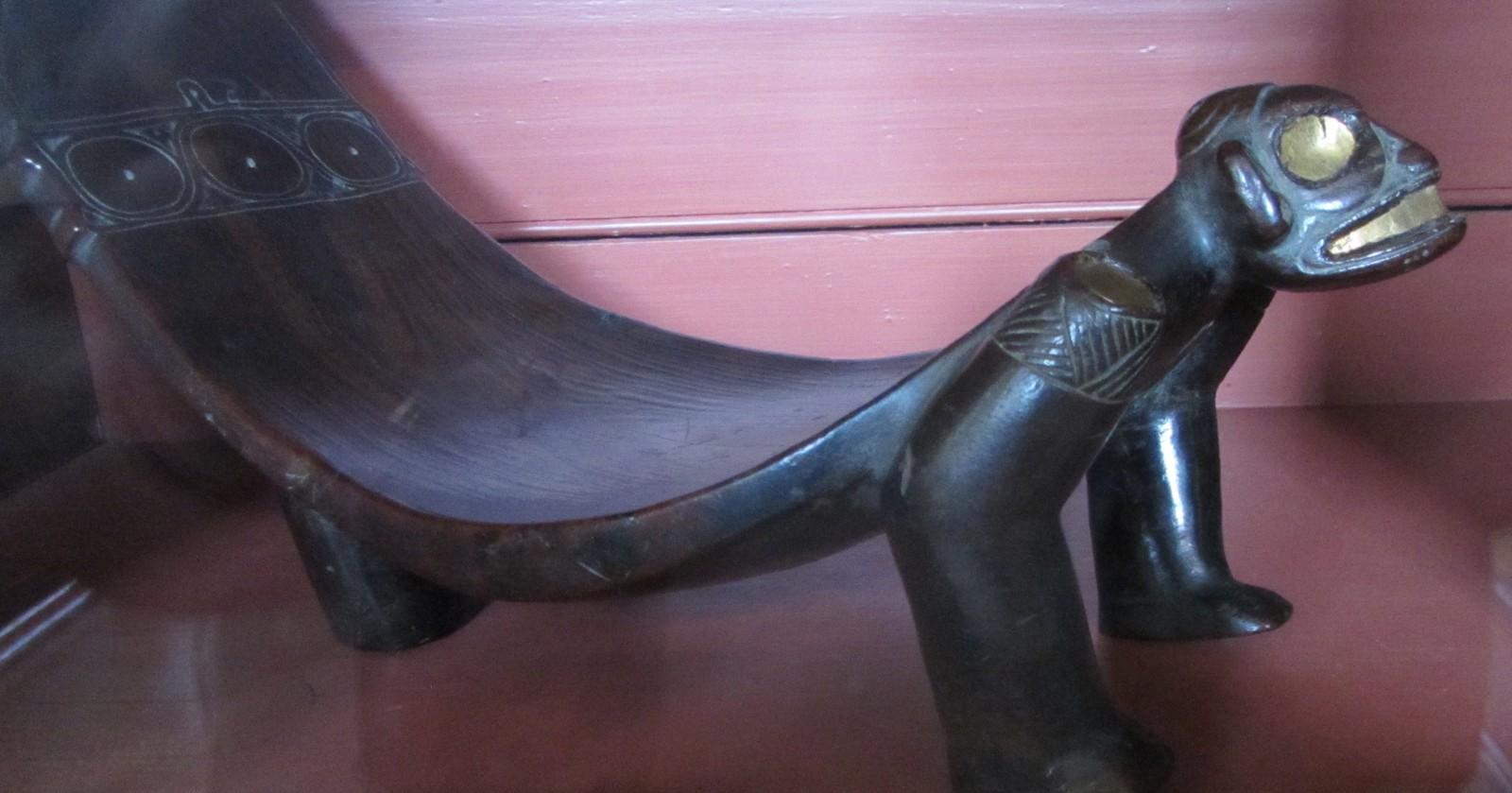
A documented wooden ritual seat from Santo Domingo, Hispaniola, with gold inlays. The museum records a calibrated radiocarbon date of 1292–1399. Maker unrecorded; documentary object photograph, taken March 25, 2012.
BabelStone / Wikimedia Commons · CC BY-SA 3.0. Resized and JPEG compressed; no cropping or other changes. Photograph retains its share-alike license.

Smarthistory · Dr. Tamara Díaz Calcaño and Dr. Lauren Kilroy-Ewbank · 2023. Museum-based historical interpretation, in English; a complete written transcript is available on the source page.
Watch on YouTube · Source & contextYouTube connects when you load the video. It may collect data and show ads or recommendations. No autoplay.
04 · POTTERY & DAILY LIFE
Clay holds skill and possibility
Potters modeled vessels with both figural and geometric decoration. The bowl at the opening combines a broad, rounded body with a projecting face. The second museum view helps us see the interior and rim. Its record identifies a ceramic container; it does not establish that it was cooking equipment or that every use was ceremonial.
At En Bas Saline in Haiti, excavations document ceramics, shell and other material traces in a particular settlement context. Archaeological context can answer questions that an isolated museum photograph cannot.
Florida Museum · En Bas Saline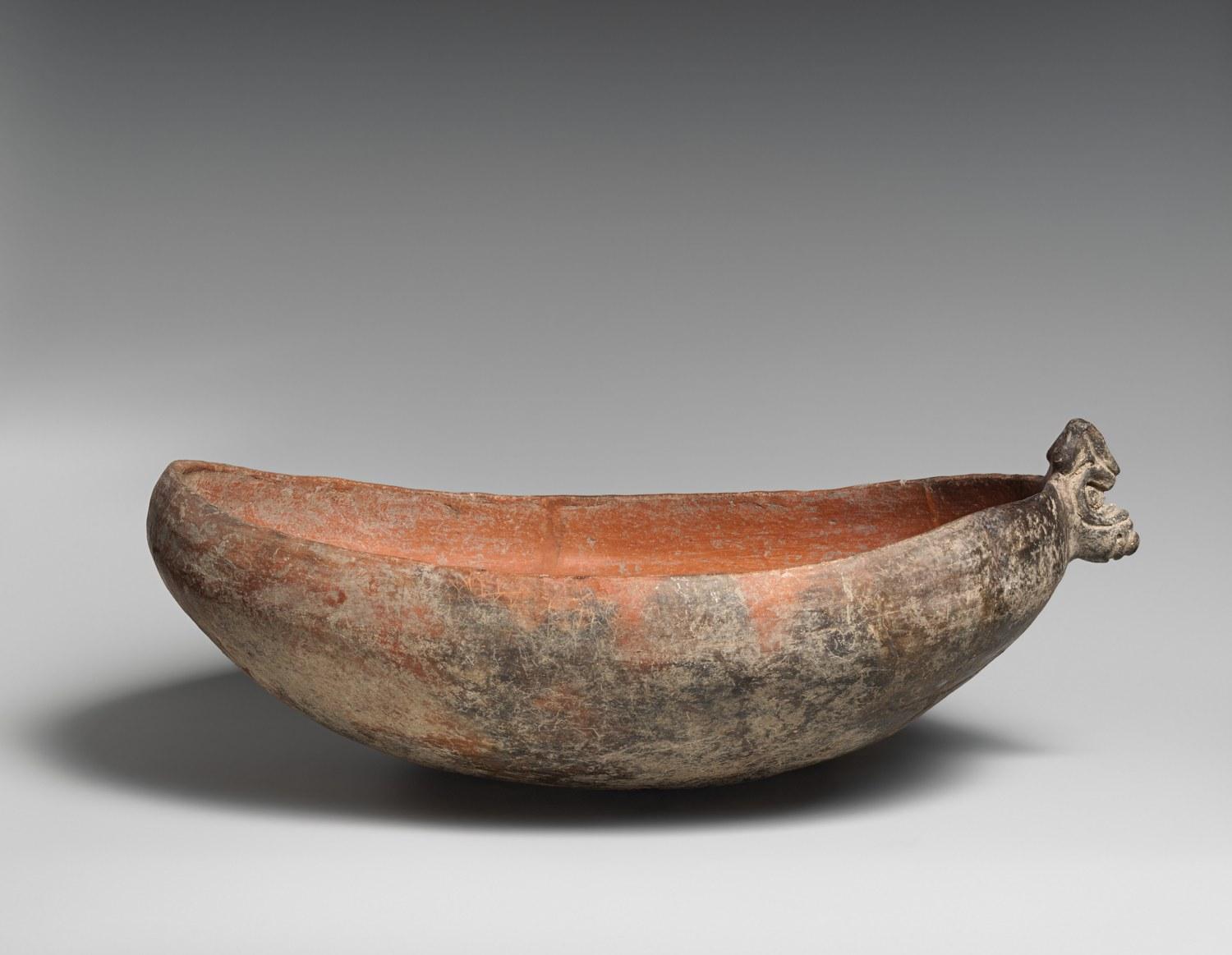
Another documented view of the same bowl, 1984.201. The modeled decoration belongs to the vessel; its full use history remains uncertain.
Maker unrecorded · 13th–15th century · Ceramic · Dominican Republic · Taíno
Object record & photograph credit
The Metropolitan Museum of Art, 1984.201. Purchase, Mary R. Morgan, Mary O'Boyle II and Mr. and Mrs. Frederick E. Landmann Gifts; The Michael C. Rockefeller Memorial Collection, Gift of Nelson A. Rockefeller and Bequest of Nelson A. Rockefeller, by exchange, and Gift of Nathan Cummings, by exchange, 1984
Photographer unidentified in the record. Documentary photograph; resized and JPEG compressed, without retouching.
05 · SHELL, STONE & PERSONAL EXPRESSION
Small works, close attention
Perforations, incised lines and shaped beads show careful work at a small scale. Collection titles identify these examples as adornment. They do not identify an individual wearer or prove that every ornament belonged to a chief. The present arrangement of beads should not be treated as a complete record of how someone wore them.
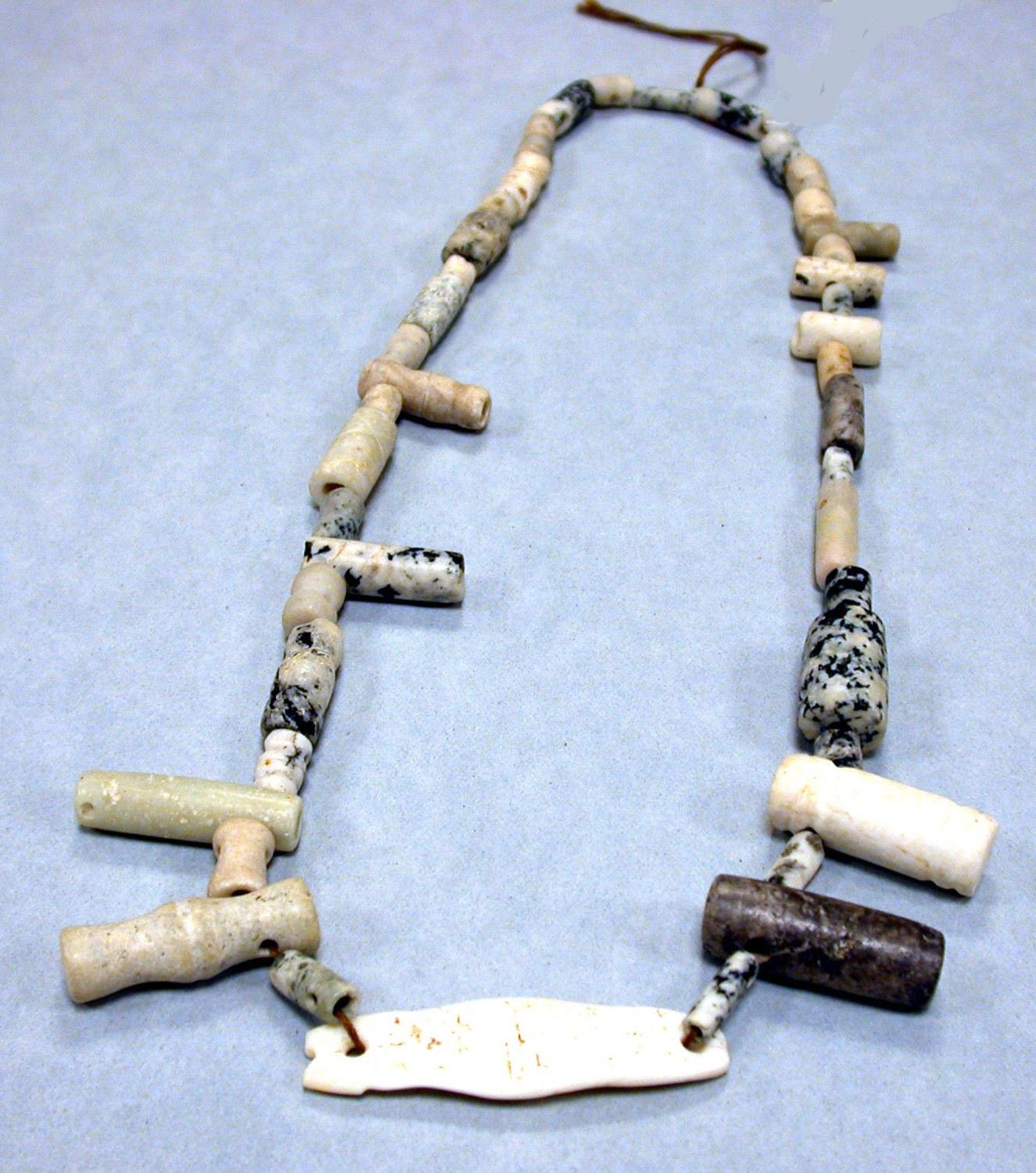
Look for the flat shell pendant, its incised surface and the holes through which it could be suspended.
Maker unrecorded · 10th–15th century · Shell · Dominican Republic · Taíno
Object record & photograph credit
The Metropolitan Museum of Art, 1984.519.2. Gift of Mr. and Mrs. Reynold C. Kerr, 1984
Photographer unidentified in the record. Documentary photograph; resized and JPEG compressed, without retouching.
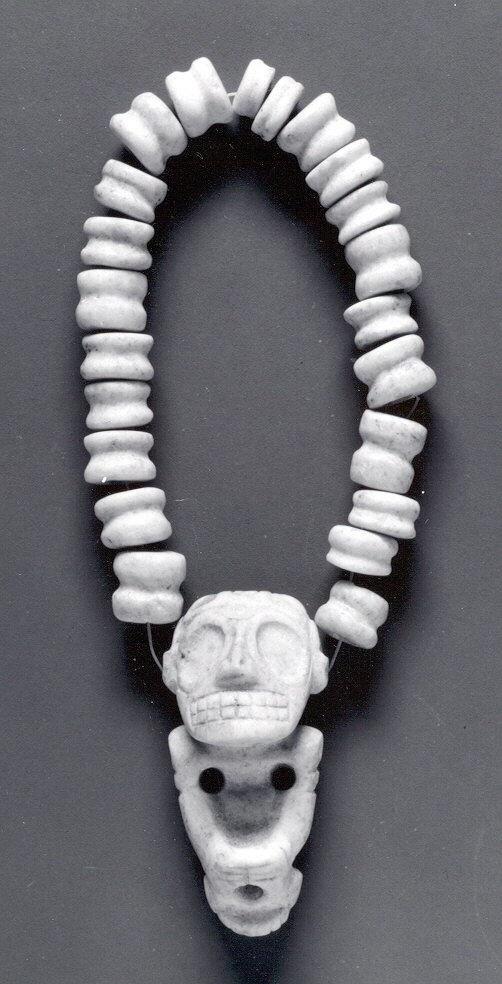
Shaped stone beads surround a carved pendant figure. Its face and perforations are visible; a particular wearer’s identity is not recorded here.
Maker unrecorded · 13th–15th century · Stone · Dominican Republic · Taíno
Object record & photograph credit
The Metropolitan Museum of Art, 1983.544.2. Gift of Vincent and Margaret Fay, 1983
Photographer unidentified in the record. Documentary photograph; resized and JPEG compressed, without retouching.
Bone also appears in documented Caribbean implements and adornment. It is not the material of either necklace shown here. This gallery makes no unverified claims about pigments, historical tattooing or the meaning of modern tattoos.
06 · COTTON & PERISHABLE ARTS
Knowledge that does not always leave a stone trace
Cotton work, hammocks and basketry belong to the history of Caribbean making. Historical accounts and exceptional surviving works help researchers study fibers, even when ordinary woven objects have decayed. Climate, storage and excavation conditions affect preservation.
Some surviving cotton ceremonial figures incorporate human remains. We have chosen not to display those images here. Sacred works deserve context and care, rather than being presented as craft templates.
Try a contemporary paper-weaving activity →07 · PETROGLYPHS, PLACE & INTERPRETATION
Rock imagery belongs to a place
Petroglyphs are carved into rock; painted rock imagery is different. At Reef Bay on St. John, the National Park Service discusses carvings near a pool and their relationships to water, reflections and ceremonial landscapes. Proposed meanings must be attributed to their interpreters.
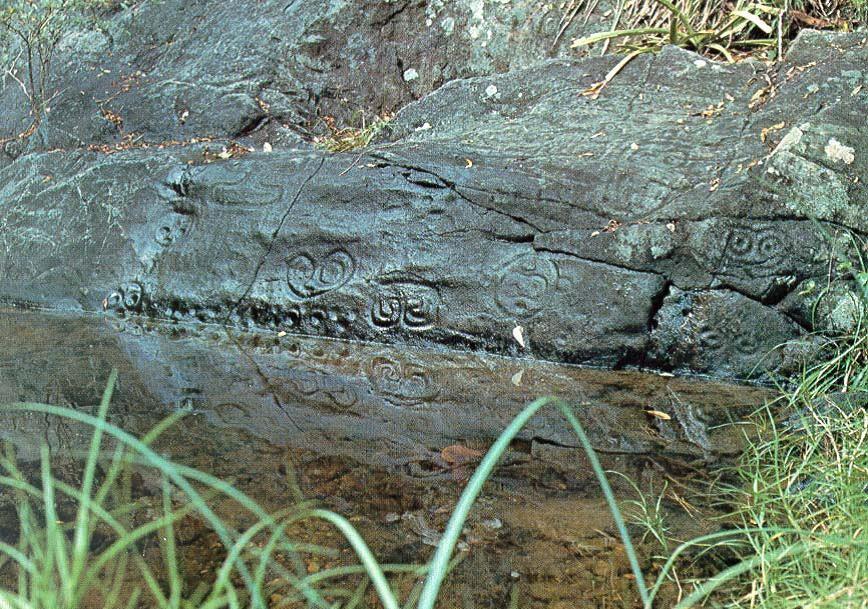
Carved rock imagery beside a pool in Virgin Islands National Park. The water reflects some of the marks. This documentary site photograph supports observation of forms and setting; it does not identify a particular deity or establish an exact carving date.
NPS Photo / U.S. National Park Service · Public domain (U.S.); confirmed in the individual asset record. Photographer name and capture date not supplied. JPEG recompressed; no cropping or other changes.
Description
What shapes and marks are physically visible?
Interpretation
What does a researcher propose, and from what evidence?
Community meaning
What meaning does a particular community give today?
Decorative adaptation
A new design is not an archaeological reading.
A spiral or an animal-like figure is not a universal dictionary entry for a deity. The site’s own photographs offer place-specific context. Do not touch, chalk, trace, rub or otherwise alter carvings.
See Reef Bay through the National Park Service08 · EXCHANGE, CHANGE & ART TODAY
Heritage can become something new
Materials and styles connect islands with one another and with the mainland, without making every Indigenous Caribbean object Taíno. After 1492, some works incorporated European and African materials. Those contact-period works belong to a different historical context from the earlier gallery.
Glendalys Medina · Atabey, 2022–23
El Museo del Barrio and Smarthistory discuss Medina’s contemporary reinterpretation through nails, thread, plywood and other materials, connecting ancestral imagery with a new abstract visual language. The museum educators’ reading of a Caguana figure belongs to that discussion; it is not a universal identification for every similar symbol. We do not assign the artist a Taíno identity or imply affiliation with this community.
Smarthistory · Dr. Susanna V. Temkin and Dr. Tamara Díaz Calcaño · 2024 · English. Museum interpretation of contemporary artwork, © Glendalys Medina. Source page includes a complete transcript; no artwork photograph is copied here.
Watch on YouTube · Source & contextYouTube connects when you load the video. It may collect data and show ads or recommendations. No autoplay.