
Learn with us · Foodways
Foodways: From Land & Sea to the Table
Ingredients, knowledge, and living culinary connections.
Taíno foodways connected cultivated gardens, forests, rivers, and coastal waters. Cassava, other root crops, maize, fruits, fish, and shellfish contributed to diets that varied across islands and environments.
Preparing food called on knowledge of plants, seasons, tools, and cooking. Today, casabe connects people with Indigenous Caribbean heritage, while contemporary recipes offer new ways to explore these ingredients.
Explore Taíno Before Colonization →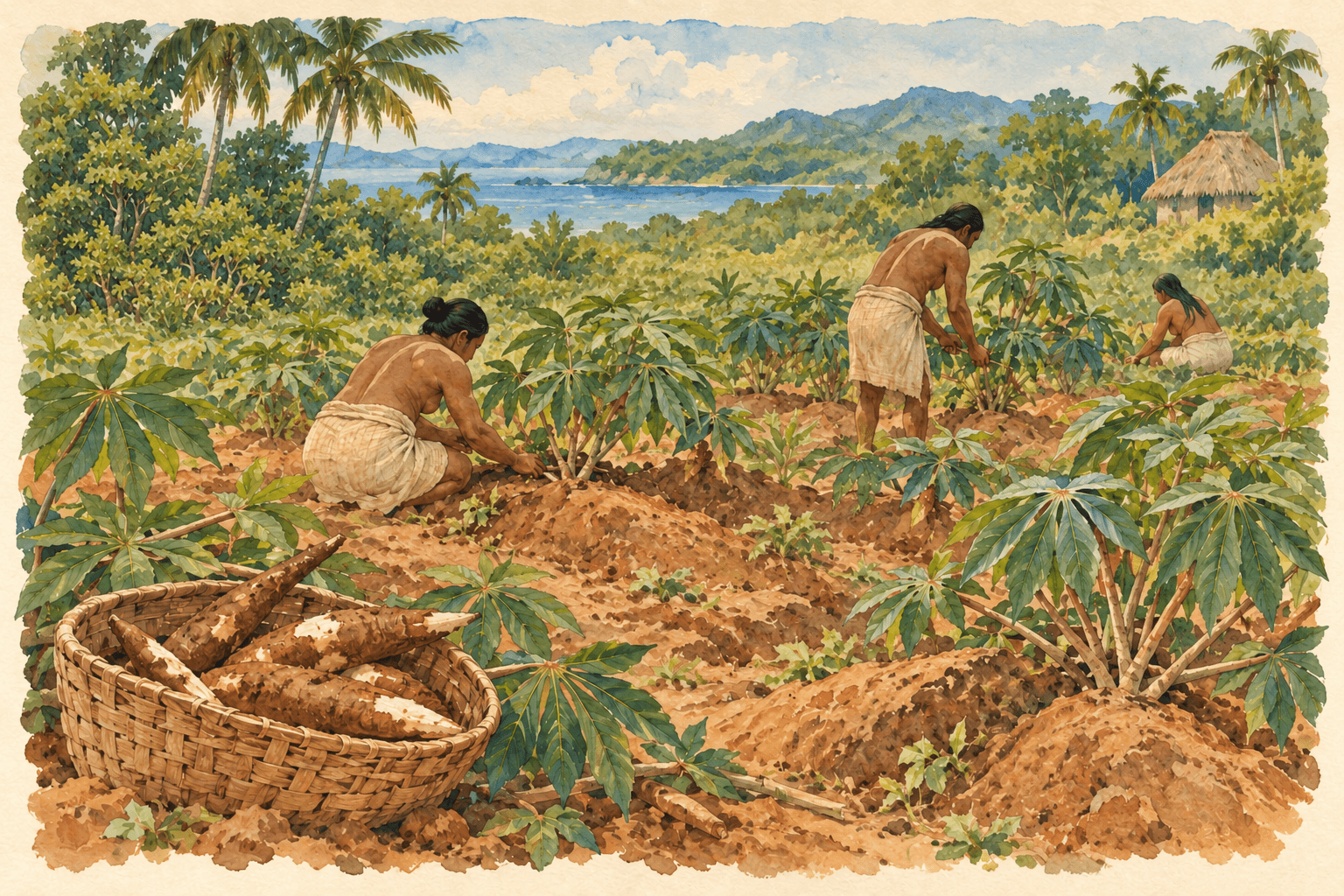
Historical context
Gardens and staple crops
Conucos were planting plots with raised earthen mounds. The Florida Museum describes cassava as a principal crop, alongside beans, peanuts, and peppers. Evidence concerns particular places and periods; it does not establish one universal menu.
Maya Jiménez’s art-history introduction includes sweet potato (batata) among Taíno crops. At En Bas Saline in present-day Haiti, botanical remains document manioc, maize, peppers, and beans. The illustrated ingredients below represent modern forms, not excavated specimens.
A plant’s American origin and evidence of its use as food are different questions. The surviving evidence varies by place and period; it does not establish a single Caribbean diet or a universal corn–beans–squash planting system.
An ingredient gallery
Contemporary ingredient illustrations · Generated with OpenAI. Not identification photographs or archaeological evidence.
Cassava / yuca
Manihot esculentaA principal crop; roots are not eaten raw.
Evidence & context →Prepared casabe
Cassava bread · Pan de yucaLiving culinary heritage; preparation varies.
Evidence & context →Sweet potato / batata
Ipomoea batatasA documented crop; illustrated colors are modern examples.
Evidence & context →Maize
Zea maysRecorded at En Bas Saline.
Evidence & context →Peppers / ají
Capsicum spp.Historical peppers; no exact ancient variety assigned.
Evidence & context →Beans
Phaseolus spp. · Modern examples / Ejemplos actualesCultivation is documented; depicted varieties are illustrative.
Evidence & context →Peanuts
Arachis hypogaeaIncluded in museum accounts of cultivation.
Evidence & context →Guava
Psidium guajavaPlant evidence from En Bas Saline.
Evidence & context →Soursop
Annona muricataRecorded at En Bas Saline.
Evidence & context →Pineapple
Ananas comosusJamaican museum context; a contemporary recipe ingredient.
Evidence & context →Coastal fish
Illustrative; species not assignedLocal fish remains provide dietary evidence.
Evidence & context →Conch shell
Illustrative shell; food use not inferredHistorical marine context; not a sourcing recommendation.
Evidence & context →Historical context
Cassava and casabe
Casabe is a thin cassava bread with Indigenous roots and continuing Caribbean traditions. Grating, removing liquid, drying or sifting the meal, and cooking on a griddle belong to documented processes whose equipment and details differ by region.
Cibucán is a term recorded for Colombia and the Dominican Republic; the related sebucán is a woven pressing implement in Colombia, Cuba, and Venezuela. Burén refers to a cooking griddle. Modern regional definitions may describe iron plates; they should not be projected onto pre-contact ceramic equipment.
Cassava contains compounds that can release cyanide. Safe processing involves more than pressing alone. The historical feature is educational, not a home detoxification method. For contemporary use, choose commercially processed culinary products or prepared casabe; follow the specific product’s instructions and never taste raw flour or dough.
Historical context
Foods from water
Fish bones and shells help archaeologists reconstruct local diets. Carlson and Keegan describe grunts, parrotfishes, groupers, snappers, and jacks in West Indian sites, alongside hook-and-line fishing, traps, nets, and weirs. Reef and shallow-water resources differed; evidence for snappers does not identify every catch as today’s red snapper.
The En Bas Saline record includes shellfish. The illustrated conch shell represents Caribbean marine resources; an image is not evidence that every shell was eaten. Identifying species and food use requires site-specific research.
Historical context
Forest foods and other animals
At En Bas Saline, hutía remains document pre-contact consumption. Carlson and Keegan report iguana in meals at Coralie, Grand Turk. These are local findings, not an island-wide animal menu. Bird remains can also reflect feathers or other uses; their presence alone does not establish food consumption.
These accounts describe history. They are not recommendations to obtain or prepare wildlife. No hutía, iguana, wild bird, or conch recipe is offered.
Historical context
Fruits, with their own histories
Guava and soursop appear in the En Bas Saline plant evidence. National Museum Jamaica’s exhibit describes pineapple and papaya cultivation in its Jamaican Taíno context. Those different sources do not establish equal evidence for all islands. Pineapple is included in the contemporary plate; papaya is discussed without an image.
Historical context
Cooking and culinary legacy
Carlson and Keegan discuss grilling, smoking, and stewing fish with vegetables and peppers. Their “pepper pots” discussion supports cooking practices, not a recovered recipe with fixed quantities. Contemporary pepperpot traditions have their own histories.
RAE–ASALE cautiously traces barbacoa to Taíno. The word’s history is different from the many histories of cooking over fire. We do not assign it a “sacred pit” translation or make every modern barbecue one unchanged Taíno dish.
Contemporary connections
A Taíno-inspired plate
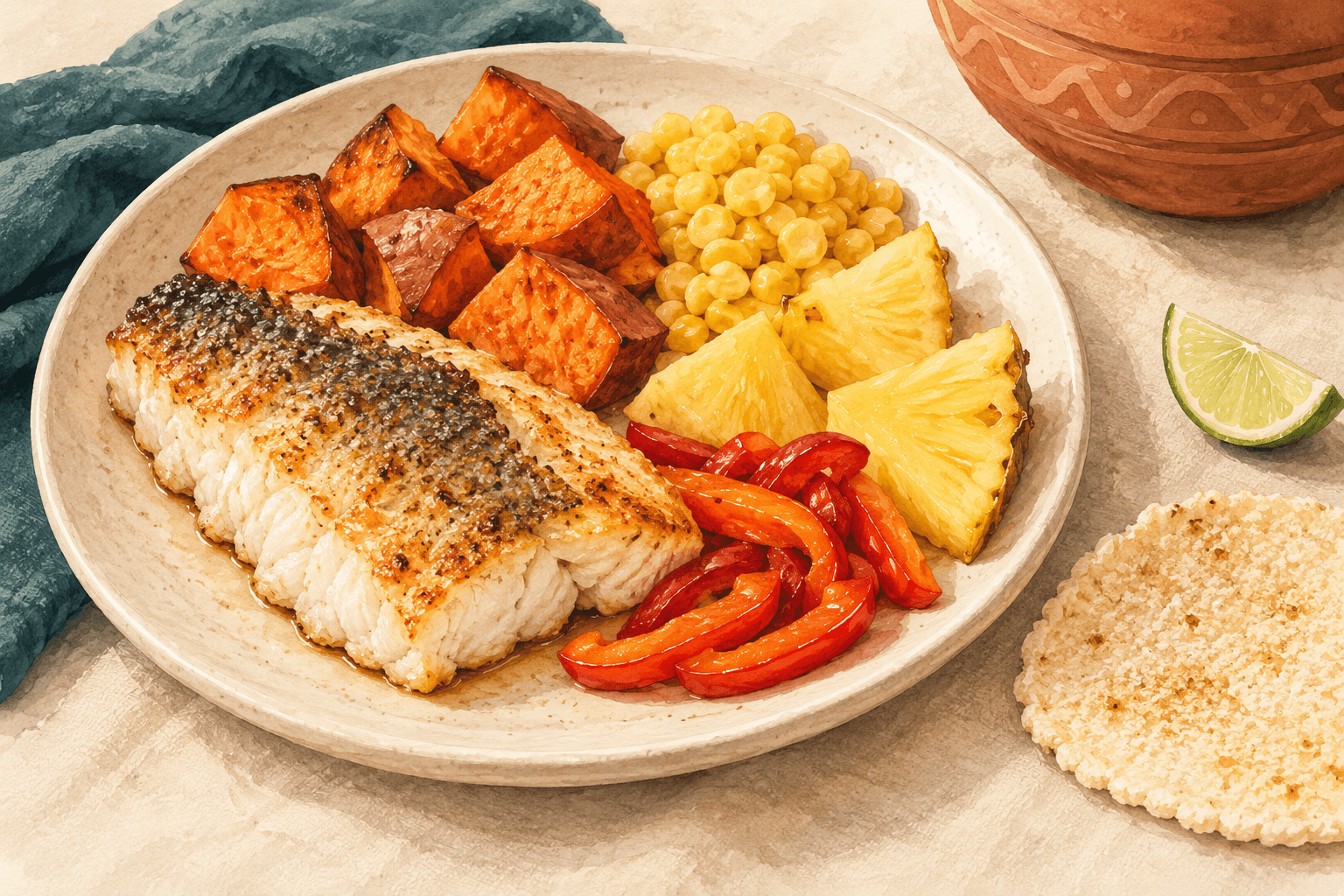
Fish, batata, maize, pineapple, and prepared casabe can come together as a contemporary serving idea. This combination is inspired by ingredients discussed in the historical sections; it is not a recovered historical recipe or a documented ancient meal.
The pictured varieties, sweet red pepper, lime garnish, commercial casabe, and modern plating are contemporary choices. Olive oil, garlic, and oven cooking are also modern additions in the accompanying recipe proposal. The illustration does not identify an archaeological fish species or show a kitchen-tested result.
Sources & Further Reading
- Florida Museum · Taíno Society
- Florida Museum · En Bas Saline: Material Remains
- Betsy Carlson & William Keegan · Catch of the Day, Florida Museum
- Smithsonian NMAI · Taíno gallery guide
- Maya Jiménez · Taíno art, an introduction
- National Museum Jamaica · The Taíno and the Spanish
- Kathleen Deagan (2004) · En Bas Saline plant evidence, Table 5
- UNESCO · Cassava bread knowledge and practices, 2024
- RAE–ASALE · Cibucán / sebucán
- RAE–ASALE · Sebucán: woven cassava press
- ASALE · Burén: regional usage
- RAE–ASALE · Barbacoa
- FDA · Naturally occurring cyanogenic compounds in cassava
- FDA · Handling Flour Safely
- Clara González · Casabe recipe, history, and video