








Draft for review · Community and editorial review pending.
Before European colonization, the Caribbean was home to diverse Indigenous societies with established communities, spiritual traditions, and connections between islands. Taíno history belongs within this wider Indigenous Caribbean world.
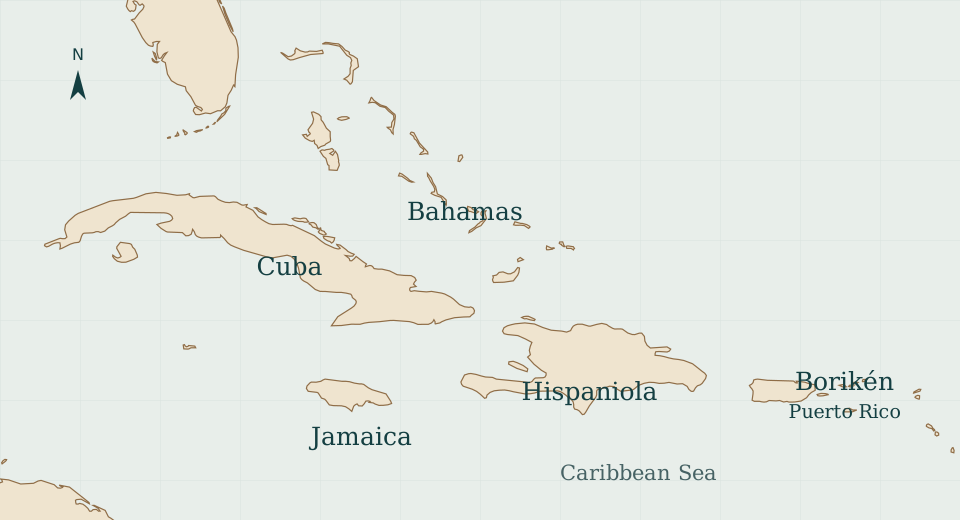
Cuba · Bahamas · Jamaica · Hispaniola · Borikén / Puerto Rico
Islands and seas to orient our reading. Hispaniola is the island now shared by Haiti and the Dominican Republic. Chiefdom boundaries and travel routes are not represented.
Profile regions: Jaragua and Higüey on Hispaniola; Loíza/Aymanio and Caguas on Borikén.
Open the full-size mapOriginal cartography with Natural Earth data · Public domain
An interconnected Caribbean
Taíno communities lived across much of the Greater Antilles and surrounding islands. They were not a single uniform society. Communities had distinct histories and participated in networks of exchange that connected people across the sea.
Canoes supported travel and connections between islands. The water surrounding these homelands was part of a connected world, rather than simply a boundary between communities.
Homes, food, and skilled making
People developed knowledge and skills suited to their island environments. Homes called bohíos used local materials, including palms and vines. Agriculture included crops such as cassava, also called manioc, and maize.
Natural materials supported weaving, pottery, and other crafts. Calabash gourds could become bowls, containers, and musical instruments. These traditions reflect practical knowledge, creativity, and relationships with the surrounding environment.
From conuco to table
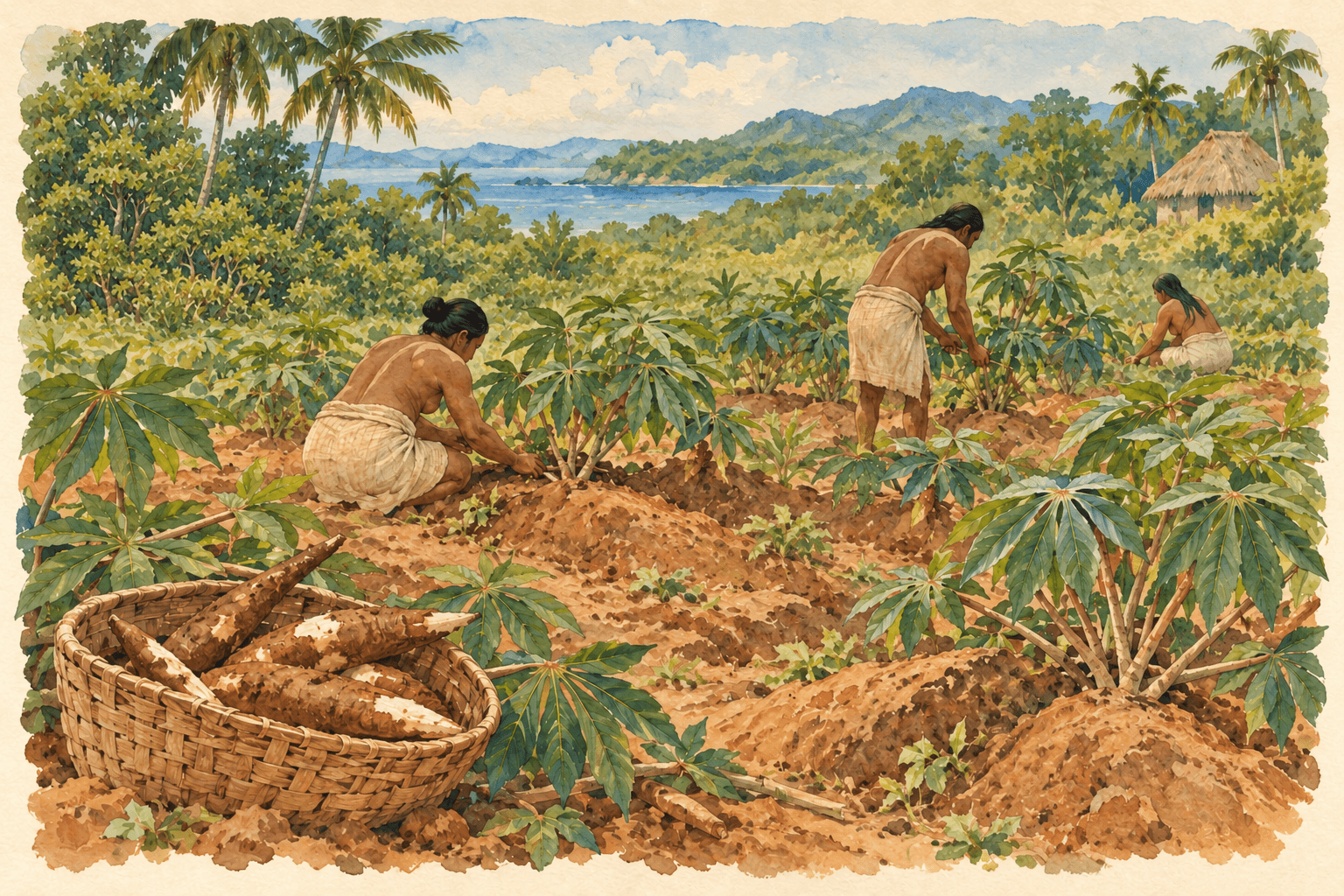
Cassava cultivation and shared work. A contemporary AI-assisted historical reconstruction informed by museum sources; not documentary evidence.
Illustration generated with OpenAI for Taíno Minnesota. Details vary by community and period.Spiritual life and ceremony
Taíno communities had their own concepts of leadership, spirituality, and ceremony before Europeans arrived. Cemís were important spiritual objects made from materials such as stone, wood, and cotton.
These objects deserve careful interpretation. Their forms and significance should be explained through documented sources rather than treated as interchangeable decorative symbols.
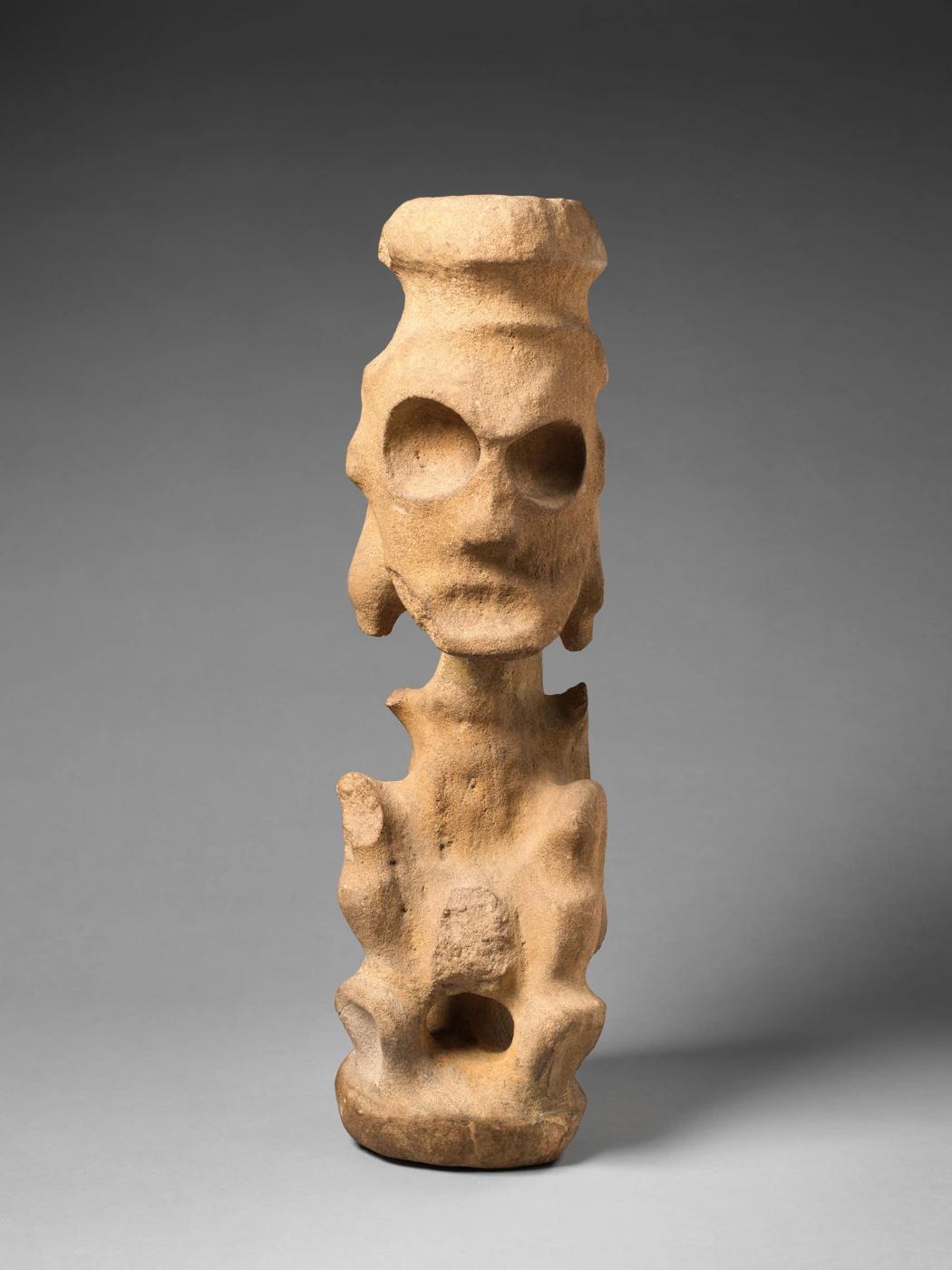
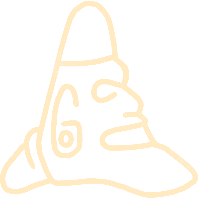
Zemí figure, unidentified Taíno artists, 1200–1500 CE. Stone. Dominican Republic (?), as recorded by the museum. No specific deity is identified.
The Metropolitan Museum of Art · 1979.206.1209Image: The Met, CC0. Photographer not identified. The Michael C. Rockefeller Memorial Collection; Bequest of Nelson A. Rockefeller, 1979.Maternal Lineage & Women’s Leadership
Maternal relationships held an important place in Taíno social organization. The Florida Museum describes Taíno societies as thought to have traced ancestry through women. Scholars debate how widely this applied. Matrilineal descent is different from matriarchal government: tracing descent through mothers does not mean that women alone governed.
- Matrilineal
- Descent traced through the maternal line.
- Matriarchal
- A system in which women hold primary governing authority.
Kinship and succession
In his 2006 commentary on L. Antonio Curet, William F. Keegan argues for matrilineal foundations, particularly in Hispaniola. The chronicles he reexamines include succession by a chief’s sister’s children, alongside other arrangements. Curet questioned what these accounts establish. Descent, inheritance, and succession should therefore not be reduced to one unchanging rule for every island.
Women as political leaders
Contact-period accounts describe women serving as cacicas and exercising political authority. The Florida Museum notes women’s participation in political hierarchies and accumulation of wealth, although paramount chiefs were often men. These records provide evidence of women’s leadership without establishing identical powers in every community.
Work and community life
The Florida Museum summarizes accounts in which men made raised planting mounds and women processed cassava, while both cultivated and harvested crops. These descriptions suggest shared responsibilities, but do not provide a complete picture of pre-contact gender roles.
Maternal figures in spiritual life
Maya Jiménez’s art-history introduction identifies Attabeira as Yúcahu’s mother and associates her with fresh water and human fertility. This is a scholarly synthesis of traditions recorded through colonial sources, not a complete statement of every community’s beliefs. Atabey appears as a maternal figure in Pané’s colonial account; its surviving versions require interpretation. Contemporary artists also interpret Atabey: Glendalys Medina’s 2022–23 work is discussed by El Museo del Barrio curator Susanna V. Temkin. Contemporary understandings deserve their own context; a maternal spiritual figure is not evidence of matriarchal government.
Cacicas: Women Who Led
Women held political authority in Taíno communities, and several appear in surviving records as cacicas, or female chiefs. Their histories reveal women’s participation in leadership while also exposing the limits of the colonial archive. Some names survive mainly in Spanish records; other accounts combine historical evidence with later community remembrance. The profiles below concern Hispaniola and Borikén, mainly during contact and early colonization; they are not a complete account of pre-contact Caribbean society.
Jaragua · Hispaniola
Anacaona
Anacaona appears in historical scholarship as a woman leader of Jaragua, on the island now shared by Haiti and the Dominican Republic. Her political authority makes her an important example in discussions of women’s leadership. Surviving colonial documentation leaves aspects of her life uncertain. The linked account places conquest, colonial violence, and her later remembrance in their historical contexts, rather than presenting a complete pre-contact biography.
Loíza / Aymanio · Northeastern Borikén
Yuisa / Luisa · Luysa in the archive
EnciclopediaPR associates the remembered cacica Yuisa, also called Luisa, with Loíza; it gives more than one explanation for the municipality’s name. Rodríguez López distinguishes two archival cacicas called Luysa of Aymanio. These references should not become one seamless biography. A remembered name, an archival spelling, and a modern place-name may be connected, but their relationship requires examination rather than an assumption that every reference describes the same woman.
Caguas region · Borikén
Yayo and Catalina
Rodríguez López identifies Yayo and Catalina as cacicas and mother and daughter. Catalina de Caguas appears in royal-estate accounts from the early colonial period, associated with the Hacienda Real del Toa and named captains. These records belong to a coercive colonial labor system; they are not evidence of voluntary employment. Family connections do not by themselves establish simultaneous co-rule or a formal system of shared maternal government.
Borikén · Agüeybaná family
Doña Inés
Rodríguez López’s reconstruction identifies Doña Inés as a cacica and the mother of the brothers known as Agüeybaná el Grande and Agüeybaná el Bravo. “Doña Inés” is a Spanish name preserved in the contact-period record, not a verified Indigenous birth name. Her recorded title and kinship warrant attention in a history of women’s authority. They do not establish an island-wide governing office, a supreme council, or a precise constitutional role.
Caguas lineage · Borikén
Doña María de Bagaaname
The 2009 presentation identifies this cacica as Doña María Bagaamane, daughter of the cacica Señora Doña Isabel and niece of Francisco Guaybanex of Caguas. This is an attributed genealogical reconstruction, not an uncontested family tree. Names and relationships need care when comparing publications. We do not identify her automatically as Caguax’s or Bagnamanay’s daughter, or treat colonial account entries as evidence that she transmitted particular cultural traditions.
Higüey region · Eastern Hispaniola
Isabel de Iguanamá
Historian Amadeo Julián names Isabel de Iguanamá as a cacica in his study of Higüey’s conquest and colonial labor distributions. Her title provides evidence that women held recognized leadership, even as the records classified Indigenous people for assignment to colonizers. Those distributions do not establish the extent or duration of her earlier authority. We do not merge her with every similarly named woman in conquest narratives.
Music and play
Music and games were part of community life. Maracas could be made from dried gourds. Taíno peoples also played batú, a game using a rubber ball that players struck with parts of the body such as their hips, shoulders, elbows, or head.
How we learn about this history
Archaeological objects, places, and research help us understand the Indigenous Caribbean before colonization. Written colonial accounts also contain information, but they require careful interpretation because they were produced through European perspectives.
Archaeological evidence, colonial descriptions, and contemporary cultural interpretations offer different kinds of knowledge and deserve to be understood in their own contexts.
Explore the next section, Colonization & Resistance, to learn about the changes brought by Spanish conquest and the people who defended their communities.
Sources & Further Reading
- Infinity of Nations: Mesoamerica/Caribbean — Smithsonian NMAI
- Taíno: Native Heritage and Identity in the Caribbean — Smithsonian gallery guide
- Zemí figure, 1979.206.1209 — The Metropolitan Museum of Art
- Taíno Society — Florida Museum of Natural History
- William F. Keegan, All in the Family (2006), Ethnohistory 53(2), 383–392
- Ramón Pané, An Account of the Antiquities of the Indians — The Haiti Reader (Duke University Press, 2020), p. 8
- Maya Jiménez, Introduction to Taíno art — Smarthistory / Khan Academy
- Glendalys Medina, Atabey (2022–23) — Smarthistory, El Museo del Barrio
- Ida Altman — The Revolt of Enriquillo and the Historiography of Early Spanish America (2007)
- American Indian magazine, Fall 2018 — Smithsonian NMAI
- Municipio de Loíza — EnciclopediaPR
- Miguel Rodríguez, Genealogía de los caciques de Borikén (2009), slides 14, 21, 25–30
- Miguel Rodríguez López, Genealogía de los caciques y cacicas de Boriquén (2010), pp. 74–91
- Amadeo Julián, La conquista del cacicazgo de Higüey… (Clío 182, 2011), p. 51